CPG Packaging Trends 2026 – Strategic Outlook for FMCG Brands
What are CPG Packaging Trends?
CPG packaging trends refer to evolving strategies in material selection, design systems, sustainability, and digital optimization that influence consumer purchasing behavior.
CPG Packaging Trends 2026: What FMCG Brands in India Must Prepare For
The conversation around packaging in India has changed dramatically in the last five years.
Earlier, packaging design for FMCG brands was seen as a one-time exercise — something done during launch or rebranding. Today, it is a living strategic asset. It influences retail shelf visibility, quick commerce conversion, sustainability compliance, and even how AI search engines interpret your brand.
From our experience working with food, personal care, and consumer brands across North India, 2026 will not be about "better looking packaging." It will be about smarter packaging — packaging that performs across retail, digital, regulatory, and environmental layers simultaneously.
Sustainability Is No Longer a Marketing Angle — It's a Structural Requirement
For years, sustainable packaging in India was treated as a premium positioning move. Brands would add an "eco-friendly" badge and consider the job done.
That era is over.
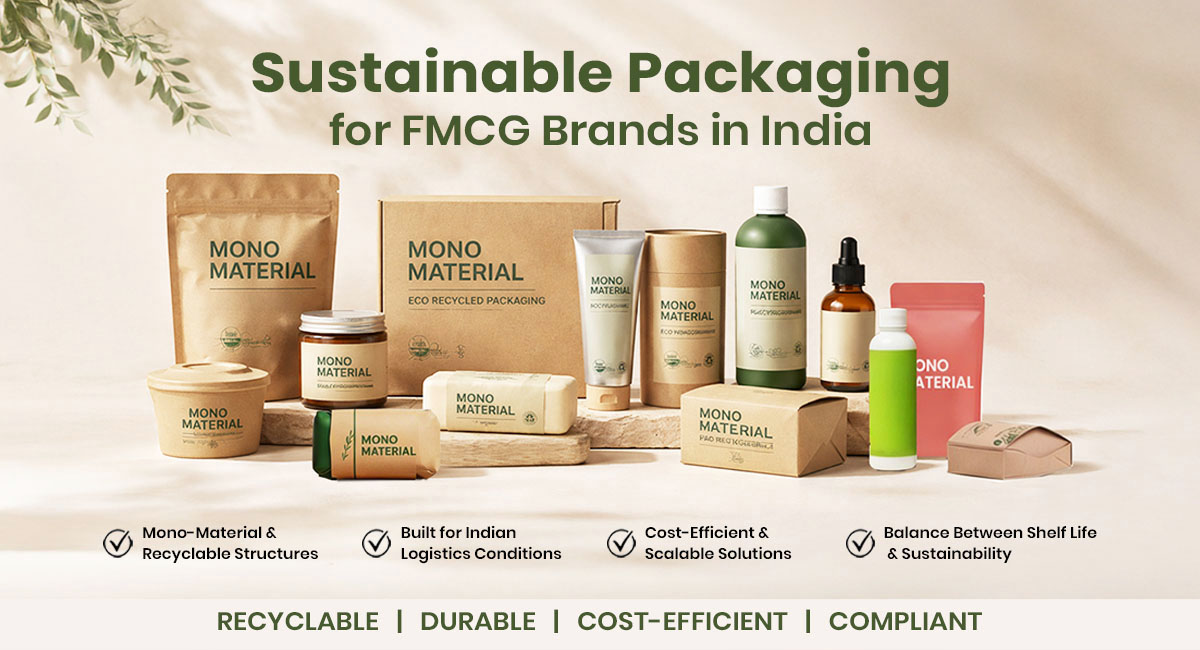
With Extended Producer Responsibility (EPR) regulations tightening and increasing compliance tracking, packaging material decisions now affect long-term operational viability. Large FMCG players are moving toward mono-material packaging, recyclable flexible films, and reduced ink coverage — not because it sounds good, but because it reduces future liability.
Switching to biodegradable or compostable materials without testing supply chain durability often leads to leakage, shelf life compromise, or cost overruns. Brands that adopt sustainable packaging too quickly frequently revert due to distribution stress in Indian heat and humidity conditions.
The smarter approach is phased evolution:
- Move from multi-layer to mono-material first.
- Reduce unnecessary lamination.
- Improve recyclability percentage before chasing compostability.
- Communicate sustainability clearly but responsibly.
In 2026, the winners will be brands that balance sustainability with performance — not those that rush for optics.
Packaging Must Perform in Quick Commerce Environments
If your packaging design is not optimized for quick commerce, you are already behind.
Platforms like Blinkit, Zepto, and Swiggy Instamart have fundamentally changed product discovery. Instead of walking down aisles, consumers now scroll through thumbnails. Instead of scanning a full shelf, they scan compressed product images.
Designs that looked strong on shelf failed digitally because:
- Typography was too small.
- Color contrast flattened in thumbnail view.
- Visual clutter reduced brand recognition.
Packaging in 2026 must survive compression. That means larger brand names, stronger contrast, and simplified visual architecture. Quick commerce has quietly forced brands to think mobile-first in packaging design — something few anticipated five years ago.
Minimalism Is Rising, But It Must Be Contextualized for India
Globally, minimal packaging trends are strong. Clean layouts, reduced color palettes, and typography-led design dominate Western markets.
In India, the situation is more nuanced.
Yes, Gen Z consumers prefer clarity over clutter. Yes, minimalist personal care brands are gaining traction. But Indian FMCG categories still require informational density — particularly in food.
The brands that are succeeding are those that balance visual simplicity with cultural context. Minimalism without clarity fails. Clarity without hierarchy overwhelms. Packaging trends in India cannot be blindly imported. They must be adapted.
Premiumization Is Moving Down the Price Ladder
Another noticeable CPG packaging trend in 2026 is the democratization of premium cues.
Earlier, embossing, foil stamping, matte finishes, and textured laminations were reserved for high-end products. Today, even mid-market SKUs are adopting premium design elements.
Matte Laminations
Even in ₹30–50 price bracket products are adopting matte finishes to signal premium quality.
Typography-Led Design
Clean, bold typefaces replacing excessive illustration — easier to produce and easier to recall.
Tonal Color Palettes
Shifting from loud primary colors to sophisticated, curated color stories across SKUs.
White Space
Strategic negative space on packaging — a luxury aesthetic that communicates confidence.
Premium packaging no longer means luxury pricing. It means refined communication.
Packaging as a Data Layer
With QR codes, traceability mandates, and smart labeling gaining momentum, packaging is becoming a digital gateway.
We are seeing more brands integrate QR codes that lead to:
- Ingredient sourcing transparency
- Recipes and usage videos
- Loyalty programs
- Authentication features
In a future where AI-powered search engines analyze structured data and brand consistency, packaging that reinforces entity clarity — brand name consistency, category alignment, ingredient positioning — indirectly strengthens digital discoverability. Packaging is no longer isolated from SEO and GEO thinking.
Cultural Storytelling Is Regaining Importance
One of the strongest emerging CPG packaging trends in India is rooted in something traditional — storytelling.
Consumers are responding strongly to brands that reflect Indian heritage while maintaining modern aesthetics. Paper Boat remains a strong example of nostalgia-driven design. Regional sweet brands modernizing their packaging without losing authenticity are gaining traction. Ayurveda-based brands are leveraging earthy palettes while improving structure and readability.
However, cultural storytelling must be intentional — not decorative. It should reinforce brand positioning, not create confusion.
What This Means for FMCG Brands in India
The Indian FMCG sector is expanding rapidly. Competition is intensifying. Shelf space is tighter. Quick commerce is compressing attention spans.
Packaging influences:
- Retail shelf visibility
- Conversion rates in quick commerce
- Regulatory compliance
- Sustainability positioning
- Brand authority signals
From an agency perspective, the brands that will win in 2026 are not those with the loudest packaging — but those with the clearest strategy. Packaging must integrate retail psychology, digital performance, sustainability compliance, and operational practicality. That is the new benchmark.
Ready to Build Packaging That Performs in 2026?
From strategic design to retail-ready execution — Sociapa Brand Studio helps FMCG brands stay ahead of the curve. Let's talk about your packaging.
Get in Touch with Sociapa Brand Studio →